Executive Summary
AI tools can help finance teams reduce repetitive work, retrieve information faster, and analyze financial data through natural-language interfaces. This whitepaper examines an on-premises AI finance agent as an alternative for organizations that need tighter control over sensitive financial data, infrastructure, costs, and auditability. The proposed architecture combines local data processing, semantic search, deterministic calculations, and a locally hosted language model to turn enterprise financial data into searchable, reviewable answers without sending sensitive financial data to third-party cloud AI services.
Why Are AI Tools Essential to Finance Teams?
Finance teams spend significant time on repetitive manual work, from searching for information across systems to preparing reports and reconciling data. As a result, AI tools have become increasingly valuable to finance teams across industries. They can help reduce manual bottlenecks, improve the accuracy of financial processes, and give teams faster access to the information they need for decision-making.
According to a KPMG study, 88% of companies are using AI in finance functions, including financial planning, accounting, risk management, treasury management, and tax and reporting operations . This level of adoption reflects the value businesses see from AI tools, particularly when they help finance teams work more efficiently.
Retrieve Information Faster
Finance and accounting teams spend significant amounts of time searching for information across disconnected systems, including general ledgers, accounts payable and accounts receivable systems, and vendor records. In fact, 50% of finance professionals spend six or more hours each week searching for information in documents before analysis even begins, while 76% report that high document volume negatively affects the accuracy or depth of their analysis.
AI tools can help finance teams retrieve information faster, allowing them to spend more time on analysis and decision-making. Accounting firms adopting AI tools finalize monthly statements 7.5 days faster than those using traditional methods. They also spend 8.5% less time on routine back-office processing.
Ask Questions in Plain English
Financial record-keeping systems were designed to record transactions, not to communicate naturally with human users. An AI finance agent allows non-technical users to ask questions about financial data in plain English, without writing SQL or building custom reports.
Instead of relying on engineering teams to write code or build custom dashboards, users can ask natural-language questions (e.g., “Show our top 5 vendors by spend concentration in Q3”) and receive immediate, verified answers.
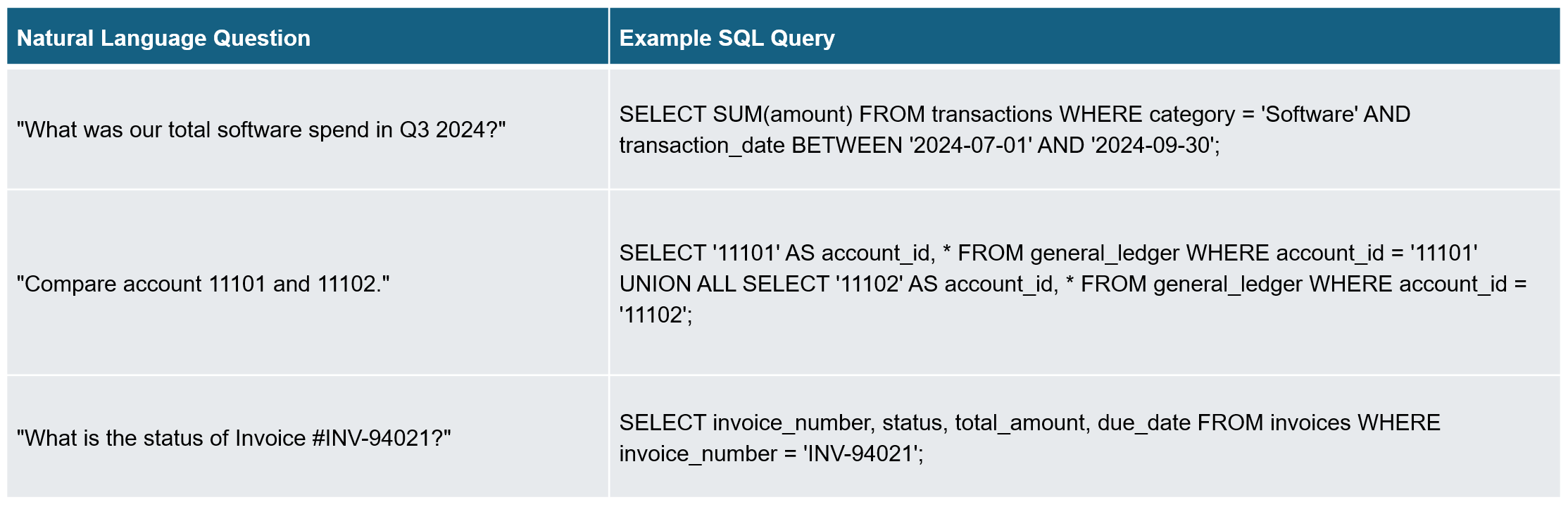
Natural-language finance questions translate into specific SQL queries depending on the underlying data-routing strategy, such as aggregations or targeted ID lookups.
The Problem with Cloud-Based AI Finance Agents
Before allowing finance teams to use cloud-based AI agents, corporations need to consider several risks.
Security Risks
Finance data contains highly sensitive records. A cloud-based AI agent may require core financial systems, such as an ERP, database, or data warehouse, to be exposed through APIs accessible over the internet. This creates additional security and data-governance considerations.
Unpredictable & Expanding Costs
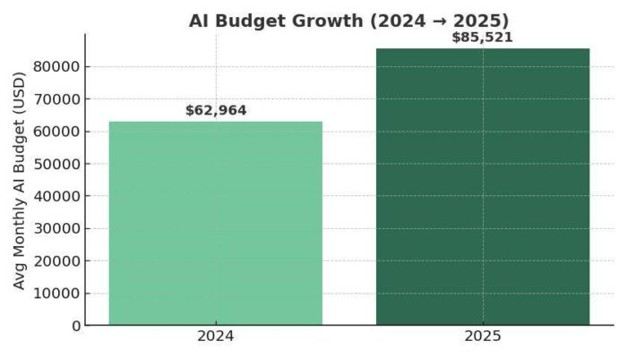
AI usage tends to expand once teams realize they can query large internal datasets conversationally. In 2025, companies spent $30,000 to $80,000 per year just to keep models running at scale. Costs can rise with:
- Token usage
- Concurrent users
- Frequent re-querying of large contexts
- API-based data orchestration layers
Regulatory and Compliance Problems
Finance teams operate within regulatory and compliance requirements that vary by industry, including rules such as SOX, GDPR, and HIPAA. Cloud-based AI can make compliance and auditability more difficult when sensitive financial data leaves the organization or when the system cannot provide a clear record of how a calculation or result was produced. An on-premises approach gives businesses greater control over data, access, and audit trails.
Solution: On-Prem AI Finance Agent
By bringing generative AI intelligence directly onto local hardware, businesses can modernize financial workflows, give non-technical employees faster access to financial information, and maintain control over sensitive financial data.
Key Advantages of an On-Prem AI Finance Agent
- Security: An on-premises AI finance agent can operate on an air-gapped server, keeping sensitive financial information within the organization and eliminating the need to send financial data to a third-party cloud AI provider.
- Cost Control: On-premises deployment avoids usage-based cloud AI costs and gives organizations direct control over infrastructure, model usage, and ongoing AI expenses.
- Compliance and Auditability: Keeping financial data and AI processing within the organization’s infrastructure provides greater control over data access and retention, while deterministic calculation tools help produce consistent, auditable financial results.
About Unigen AI Finance Agent
The Unigen AI Finance Agent is an on-premises financial intelligence system designed to help finance teams quickly search, analyze, and understand enterprise financial data. It combines natural-language querying with local data processing and deterministic calculations to provide reliable answers without sending sensitive financial data to the cloud. The system is designed for practical, day-to-day use across finance and accounting workflows.
Key Capabilities
- Plain-English Querying: Staff ask questions naturally (e.g., “Show our top 5 vendors by spend concentration in Q3”) without writing SQL or building manual pivot tables.
- Exact-ID Lookup: Instant indexing across vendor numbers, invoice IDs, and specific account ledgers.
- Deterministic Calculations: Perform accurate totals, counts, comparisons, and threshold-based analysis using a deterministic calculation engine rather than relying on the LLM to perform financial calculations.
- Audit-Ready Exports: Answers generate dynamic data visualizations alongside downloadable PDF reports or Excel files containing every underlying raw row used in the calculation.
- 100% On-Prem Processing: Runs entirely on internal hardware using the SAKURA-II accelerator and Gemma 4 12B, keeping financial data within the organization’s infrastructure and away from third-party cloud AI services.
- Multi-User Scale: Concurrent browser-based access across company-approved PCs and mobile devices operating on the internal network.
Process Flow
The AI Finance Agent follows a multi-step process to turn raw financial data into searchable, reliable answers. In Unigen’s implementation, Oracle is used as the source financial system; however, the architecture is designed to be portable to other financial and enterprise data systems that can provide structured data exports or accessible data interfaces.
First, seven Oracle data exports are cleaned and standardized before being indexed in a local FAISS vector database. When a user submits a question, the system routes it based on the type of query: exact IDs are matched directly, general questions use semantic search, and questions requiring calculations are handled by a deterministic Pandas aggregation engine. The relevant data is then provided to the local Gemma 4 12B model running on SAKURA-II hardware to generate a natural-language response. Users can review the answer through the Streamlit interface and export results as PDF or Excel files, including the underlying data used for calculations.
Process Components
- Finance Data: Oracle CSV exports (AP, GI payments, vendors, COA)
- Cleaning Scripts: Encoding, headers, and banners
- LlamaIndex Documents: Row-to-text conversion
- Vector Index: bge-small-en-v1.5 embeddings
- Local LLM Engine: Gemma 4 12B running on SAKURA-II on SAKURA-II
- Query Engine: Combines context and question
- Streamlit UI: Web interface
- User Question: Typed in browser
- Output: Natural-language response and exportable results
Output and Review Features
- PDF export for every answer
- Excel export including underlying matching rows for aggregation results
- Token tracking and example-question guidance
- Automatic visualizations for selected numeric responses
Technology Stack
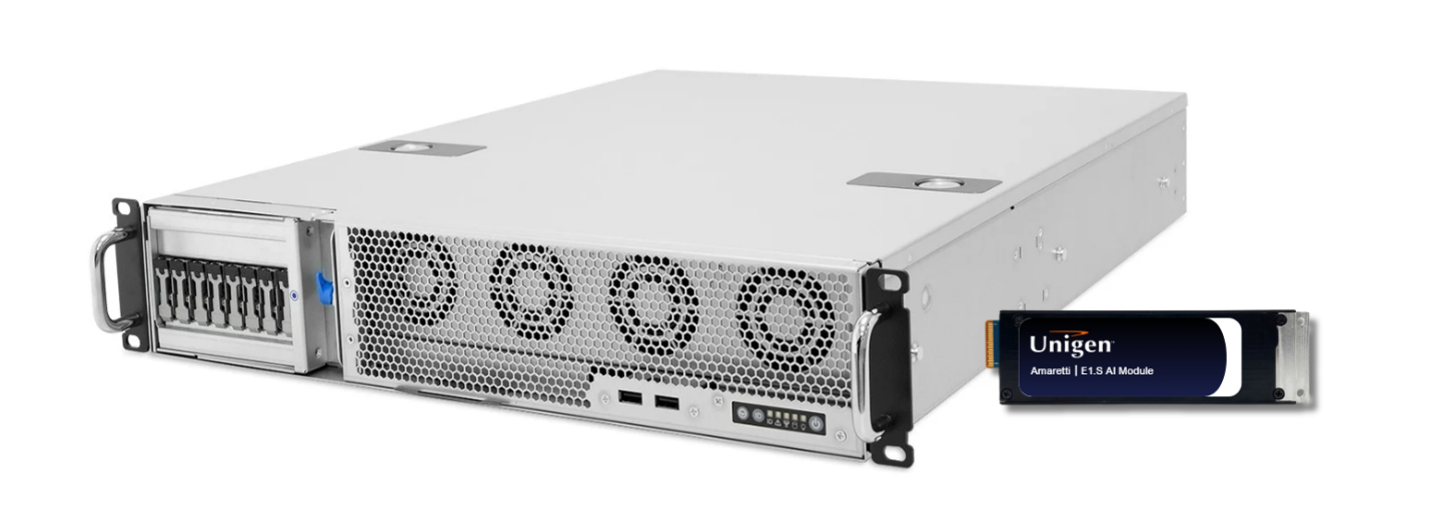
- Hardware: Unigen Poundcake_LLM Server equipped with 8 Amaretti AI Modules (32GB) and EdgeCortix SAKURA-II accelerator environment.
- LLM Engine: Local Gemma 4 12B model running entirely on-device.
- Data Processing Layer: FAISS local vector database for fast semantic searching combined with a Pandas-based deterministic calculation layer.
- User Interface: Lightweight Streamlit web application cached for rapid load times across internal network devices.
Conclusion
AI finance agents are likely to become an increasingly common tool for finance teams, but security, data control, and cost predictability remain important considerations. An on-premises approach allows businesses to use AI for financial data retrieval and analysis while keeping sensitive information within their own infrastructure. By combining natural-language access with local data processing and deterministic calculations, an AI finance agent can make financial workflows more efficient without requiring organizations to give up control of their data or infrastructure.
About Unigen Corporation
Founded in 1991, Unigen is an established global leader in the design and manufacture of OEM products including SSDs, DRAM modules, NVDIMMs, Enterprise IO, and AI solutions. Unigen also offers a full array of Electronics Manufacturing Services (EMS), including design, quick-turn prototyping, new product introduction, volume production, supply chain management, assembly & test, and aftermarket services. Headquartered in Newark, California, the company operates state-of-the-art manufacturing facilities (ISO-9001/14001/13485 and IATF 16949) in the heart of Silicon Valley as well as offshore in Vietnam and Malaysia. Unigen offers its products and services to customers worldwide targeting a broad range of end markets including automotive, computing and storage, embedded, medical, AI, robotics, clean energy, and IoT. Learn more about Unigen’s products and services at Unigen.com.
Glossary
- Air-Gapped: A security measure in which a computer, network, or system is physically isolated from unsecured or public networks, such as the internet. This separation reduces the risk of unauthorized access, data leakage, or cyberattacks.
- Deterministic Calculation: A calculation performed by a defined computational process that produces consistent results from the same inputs, rather than relying on a language model to perform the arithmetic.
- ERP (Enterprise Resource Planning): A business software system used to manage and integrate core organizational processes and data.
- FAISS: A library used for efficient similarity search and clustering of dense vectors. In this whitepaper, FAISS is used as a local vector database for semantic search.
- GDPR (General Data Protection Regulation): The European Union’s comprehensive data-protection law governing how personal data is collected, processed, and stored.
- HIPAA (Health Insurance Portability and Accountability Act): U.S. federal legislation establishing privacy and security requirements for protected health information.
- LLM (Large Language Model): A machine-learning model trained to understand and generate natural language. In this whitepaper, the LLM is Gemma 4 12B.
- Natural-Language Querying: The use of ordinary human language to ask questions of a data or software system without directly writing database queries or code.
- On-Premises: Deployed and operated on an organization’s own physical infrastructure rather than hosted by an external cloud provider.
- Semantic Search: A search method that uses the meaning or conceptual similarity of text to retrieve relevant information rather than relying only on exact keyword matches.
- SOX (Sarbanes-Oxley Act):S. legislation establishing requirements related to corporate financial reporting, internal controls, and accountability.
- SQL (Structured Query Language): A language used to query and manipulate data in relational databases.
- Streamlit: A framework used to build interactive web applications for data and machine-learning workflows.
- Vector Database: A system that stores numerical vector representations of data and supports similarity-based retrieval.
Sources
Hebbia: Finance Teams Spend Hours Each Week Searching For Data Buried in Documents
Stanford Business: AI Is Reshaping Accounting Jobs by Doing the “Boring” Stuff
Ficus Technologies: Why AI Is So Expensive in 2025: Breaking Down the Real Costs